
Best Racquet Club Software: What Modern Clubs Should Actually Look For
The hardest part about evaluating racquet club software is that almost every platform can produce an impressive-looking feature list. Reservations? Check. Programs? Check. Payments? Check. Member database? Check. Put enough checkmarks on a comparison sheet and the products can start looking interchangeable.
They aren't.
The difference becomes much clearer when you stop looking at software as an administrator and start following an actual member through the club. They want to play Saturday morning, but their regular partner is away. They find someone at a similar level, reserve a court, message them, play the match, and decide to enter a doubles tournament together. A few weeks later they take a lesson, get feedback on their swing, drop their racquet off to be restrung, and join a ladder. In a great club, those experiences don't feel like separate departments. They are simply part of being a member. Your technology should work the same way.
Racquet Sports Have Changed Faster Than Club Software
The scale of racquet sports participation makes this more important than it was even a few years ago. The USTA reported that 27.3 million Americans played tennis in 2025, with 14.5 million playing at least 10 times during the year. Perhaps more importantly for clubs, 80% of 2024 tennis players returned in 2025, the highest retention rate the USTA had measured in five years. USTA See the USTA's 2026 U.S. Tennis Participation Report
Pickleball has followed an even steeper trajectory. The Sports & Fitness Industry Association reported 24.3 million U.S. pickleball participants in 2025, compared with approximately 4.2 million in 2020. The number of core players, defined as playing eight or more times per year, grew from 1.4 million to 7.5 million over that period. Sports & Fitness Industry Association Read SFIA's latest pickleball participation data
Then there is padel. The International Padel Federation reported more than 35 million active players worldwide in 2025, with the number of clubs growing 16.1% and courts growing 15.2% in a single year. Padel FIP Explore the FIP World Padel Report 2025
Those are different sports and different populations, so the figures shouldn't be added together. But they point to the same operational reality: today's racquet club is serving more players, more types of play, and increasingly more than one racquet sport. Software designed primarily as a reservation calendar has a hard time keeping up with that.
The Best Racquet Club Software Should Create Participation
Court reservations matter. They just aren't the end goal.
A member doesn't really want a 10:00 a.m. reservation. They want a tennis match. They don't want a registration confirmation. They want to play in a pickleball league. They don't want access to a member directory. They want to find someone they actually enjoy playing with.
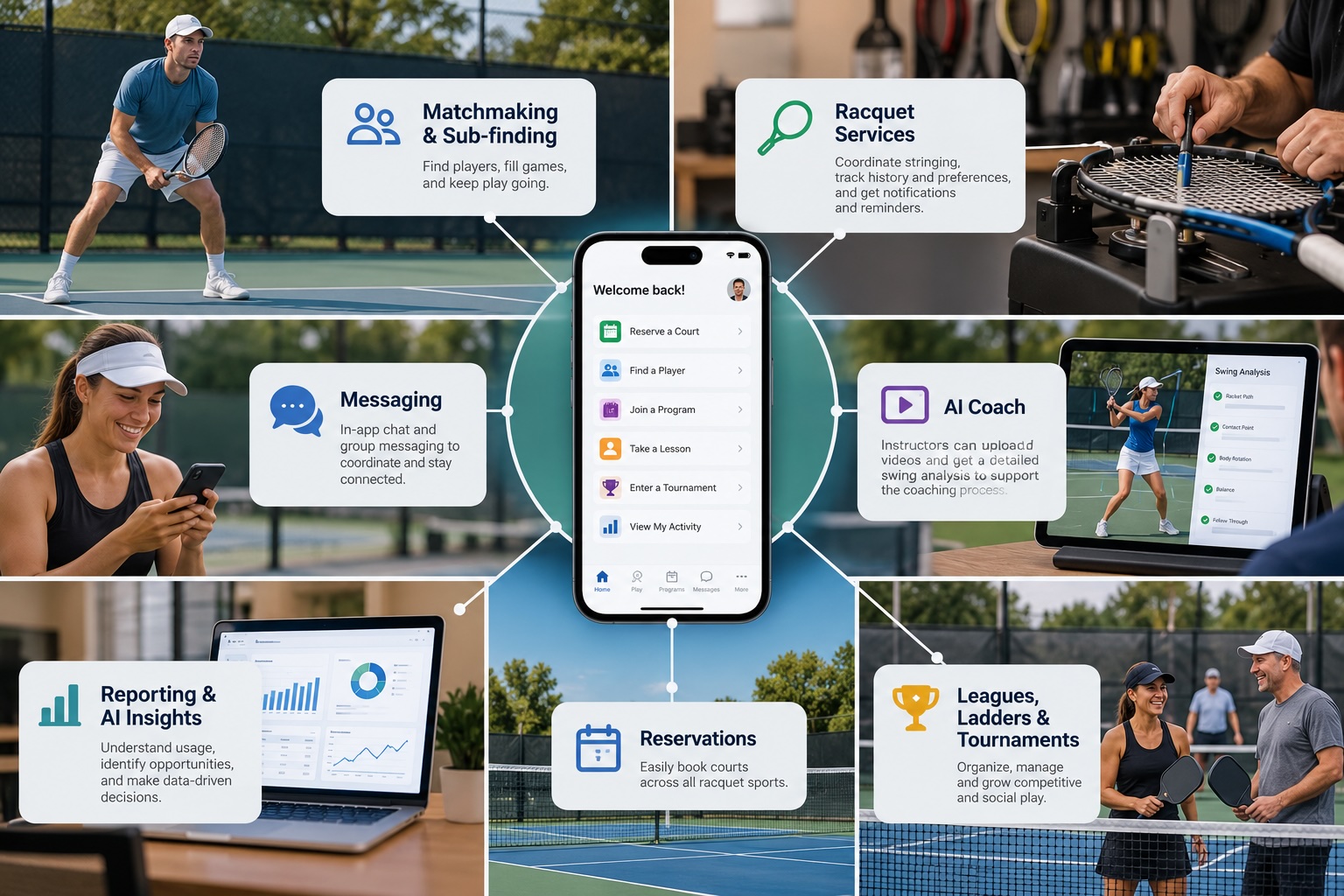
That distinction has influenced a lot of how we've built CourtMatch. Matchmaking helps players find compatible people. Subfinding helps save a game when somebody cancels. In-app chat and group messaging let players coordinate without immediately disappearing into text chains, WhatsApp or GroupMe. Leagues, ladders and tournaments give people more reasons to play, while their results and accomplishments become part of their member profile rather than disappearing when an event ends.
The value isn't any one of those features. It is what happens when they work together. Matchmaking can lead to a reservation. A reservation can lead to a friendship. That friendship might lead to a league team or tournament entry. The tournament creates an accomplishment that becomes part of the member's identity inside the club. Each experience makes the next one easier.
That's a very different philosophy from software that simply processes transactions.
Don't Confuse "All-in-One" With "Everything Is Connected"
This is an important distinction because "all-in-one" has become a fairly loose phrase in club technology. A platform can have a long list of modules without those modules contributing much to one another.
When evaluating racquet club management software, I would pay close attention to what happens between features. Does a tournament exist completely separately from a player's profile? Can members communicate with the people in their league inside the same app? Can someone looking for a game actually find another member and then reserve a court? Can an instructor, lesson, player and court all exist within the same workflow?
The administrative advantage of integration is fewer systems to manage. The member advantage is much bigger: fewer dead ends.
This also matters for clubs offering multiple sports. Tennis players, pickleball players and padel players may use the facility differently, but they shouldn't need completely different digital experiences. Club leadership should be able to operate the facility as one community while still supporting the rules, formats and culture of each sport.
Think Beyond the Reservation
One of the opportunities we see in racquet club technology is supporting parts of the member experience that historically haven't been connected to club software at all.
Take racquet services. Getting a racquet restrung is a normal part of playing tennis, but the process at many clubs is surprisingly informal. A player drops off a racquet, tells someone their preferred string and tension, and hopefully that information follows the racquet through the process. With CourtMatch Racquet Services, players and administrators can coordinate service, maintain a history of previous work and player preferences, and receive reminders and notifications when appropriate.
Coaching is another example. An instructor may see something during a lesson that is difficult for a player to understand in real time. CourtMatch's AI Coach allows instructors to upload video of a member and receive a detailed analysis of the swing that can be used as another aid in the coaching process. It isn't intended to replace the instructor. The instructor remains the coach. The technology gives them another tool for helping a member understand what they're doing and where they can improve.
Neither feature has much to do with reserving a court, which is precisely the point. Racquet club management is bigger than court management.
Staff Should Feel the Difference Too
Member engagement shouldn't come at the cost of creating more work for employees. In fact, a good racquet club platform should do the opposite.
A cancellation should trigger a smart waitlist instead of requiring somebody to start calling members. Recurring lessons shouldn't need to be recreated every week. Staff should be able to evaluate instructor and court availability together. Waivers should follow the appropriate membership, event or program. Tournament administration shouldn't require exporting members into another system and then bringing results back later.
The test I like is simple: every time staff manually move information from one system to another, send a message because two systems don't communicate, or maintain a spreadsheet because the club software can't handle something, there is probably an opportunity for better technology.
Automation isn't valuable because automation sounds sophisticated. It is valuable because it gives staff time back to interact with members.
Member Engagement May Be the Most Important Feature You Can't Put in a Checkbox
This is where comparing racquet club software becomes difficult. It is easy to put "reservations" or "tournaments" into a spreadsheet. It's harder to put a checkmark next to "helps a new member become part of the club."
But that may ultimately matter more.
The latest participation research across tennis, pickleball and padel isn't just showing that more people are trying racquet sports. Tennis is seeing stronger retention and more frequent play. Pickleball's core participant population has grown dramatically. Padel is rapidly adding clubs and courts around the world. USTA
For clubs, the opportunity is not simply to accommodate that demand. It is to turn participation into relationships, routines and community.
So when you're trying to choose the best racquet club software, compare the administrative features. Compare pricing. Compare reporting, reservations, memberships and payments. Those things matter.
Then spend just as much time asking what the software will actually help your members do.
Can they find someone to play with? Can they communicate? Can they join organized play without leaving the platform? Can their accomplishments become part of their club identity? Can instructors use technology to deliver a better coaching experience? Can the club remember how they like their racquet strung? Can one interaction naturally lead to another?
That's when club software stops being a system members have to use and starts becoming part of the experience they joined the club to have.