
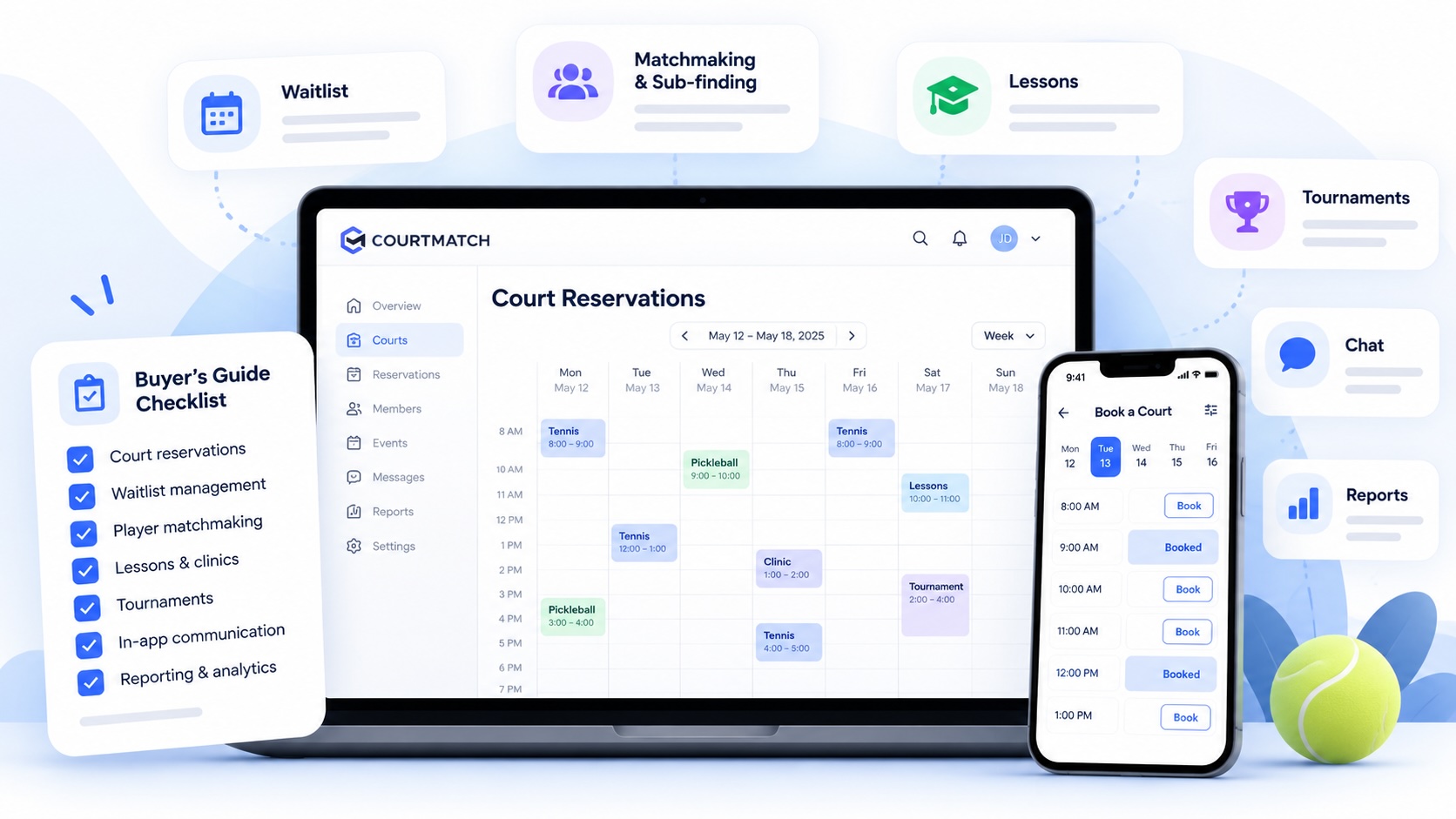
Court Reservation Software Buyer’s Guide: What to Look for Before You Choose
A court reservation calendar can look fantastic in a software demo and still turn out to be the wrong system for your club.
The problem is that reservations are easy to demonstrate. Pick a date, choose a court, select a time, click book. It takes about 30 seconds, and almost every serious court reservation software platform can do it. The differences usually show up later, when a doubles player cancels, a clinic fills up, a new member can't find anyone to play with, an instructor needs a court, a tournament takes over six courts for the weekend, or staff realizes they're maintaining three other apps and a spreadsheet just to make everything work.
That's why buying court software shouldn't really start with the calendar. It should start with what happens around the calendar.
The timing matters. U.S. tennis participation reached a record 27.3 million players in 2025, with 14.5 million people playing at least 10 times during the year and more than 616 million total play occasions. USTA Pickleball reached 24.3 million U.S. participants, up from roughly 4.2 million in 2020. Sports & Fitness Industry Association Padel is expanding globally as well, with the International Padel Federation reporting more than 35 million players, 24,600 clubs, and 77,300 courts worldwide in its 2025 report. Padel FIP
More people playing means more reservations, but it also means more leagues, lessons, tournaments, waitlists, communication, matchmaking, programming, and competition for desirable court times. The best court reservation software needs to handle that entire environment.
The Reservation Calendar Is Table Stakes
Start with the basics because they still matter. Members should be able to quickly see available courts, understand what they are eligible to reserve, and complete a booking without calling the front desk. Administrators should be able to establish booking windows, reservation lengths, cancellation policies, guest rules, court restrictions, prime-time rules, and different permissions for different types of members.
Pay particular attention to complexity. A six-court neighborhood facility may have relatively simple rules. A private club may need different booking privileges for tennis and pickleball, restrictions by membership category, junior policies, guest limits, recurring reservations, team practices, lesson blocks, maintenance periods, and special events. Software that handles a simple reservation beautifully isn't necessarily software that handles complicated rules gracefully.
During a demo, don't let the vendor show you only the ideal booking. Ask them to show you the annoying ones. Book adjacent time slots. Cancel during a restricted window. Add a guest. Change a player. Reserve courts for a recurring lesson. Block six courts for an event and then modify only one occurrence. The strange situations usually reveal more than the normal ones.
A Reservation Isn't the Same Thing as a Game
This is probably the biggest philosophical difference between traditional court booking software and where I think club technology is heading.
Suppose a member sees an open court tomorrow at 4:00. Great. But they don't have anyone to play with.
The software has successfully identified available inventory while failing to solve the member's actual problem.
A better question for vendors is: How does your software help turn an available court into people playing on it?
That can include matchmaking, sub-finding, open play, leagues, ladders, tournaments, clinics, and other ways of bringing players together. At CourtMatch, we built matchmaking and sub-finding directly into the platform because finding the right court time and finding the right people to play with are really parts of the same problem.
This becomes particularly important for new members. A new player may have access to every court at the club and still have a poor experience because they don't know anyone. Software can either leave relationship-building entirely to chance and staff introductions, or it can help accelerate those connections.
The participation numbers make this more important. The USTA found that 80% of people who played tennis in 2024 returned in 2025, a five-year high for retention, while 4.9 million people played for the first time. USTA Clubs have a significant opportunity to turn new players into regular players. Technology should help.
Look at What Happens When Plans Change
Court schedules rarely stay exactly as they were originally booked.
People cancel. Someone gets injured. Weather changes. A lesson moves. A tournament runs long. Three people still want to play after their fourth drops out.
Good reservation software needs to handle change without forcing staff to become human middleware.
Waitlists are a good example. If a program or event is full and someone cancels, the system should be able to help fill that opening. A smart waitlist is more valuable than a static list of names because an empty spot is lost participation and, in many cases, lost revenue.
Sub-finding is another example. If one person drops out of a doubles reservation, canceling the entire game should not be the easiest option. The technology should help the remaining players find someone appropriate who might want to play.
This is an area I would test very deliberately in any software evaluation. Don't ask, "Do you have waitlists?" Ask the vendor to show you exactly what happens when somebody cancels.
Organized Play Belongs in the Evaluation
Reservations are only one way members use courts. Leagues, ladders, tournaments, team matches, round robins, clinics, social events, and organized open play can account for a significant portion of court activity.
That creates two questions.
First, can administrators manage those activities without manually piecing together the schedule? If a tournament uses courts 1 through 8 on Saturday morning, the reservation system should understand that those courts are unavailable. Staff shouldn't be reconciling two calendars.
Second, what does the member experience look like? Can someone discover an event, register, communicate, participate, report a result, and see their history without jumping between several unrelated systems?
At CourtMatch, we decided tournaments, leagues, and ladders should live inside the same platform as reservations. A tournament result can then become part of a member's profile, including trophies and accomplishments. That may seem unrelated to court booking at first, but that's exactly the point. The reservation is only one small part of why the member came to the club.
Communication Is Part of Court Management
A surprising amount of court coordination happens outside court software.
- "Are we still on for tomorrow?"
- "Can anyone play at 6?"
- "We need one more."
- "Which court are we on?"
- "Does anyone want my spot?"
Those conversations move into text messages, email, WhatsApp, GroupMe, or whatever system the members happen to use. That works, but it fragments the club experience and can make it especially difficult for new members to become part of existing groups.
When evaluating court booking software, consider both communication from the club and communication between members. Push notifications, emails, and reminders are useful, but they are different from direct messaging and group conversations.
CourtMatch includes in-app chat and group messaging because we view communication as part of participation. If people are already using the app to find players, reserve courts, join leagues, and enter tournaments, it makes sense for the conversations surrounding those activities to happen there too.
Lessons Require More Than an Instructor Calendar
Instruction creates another layer of scheduling complexity because there are usually three things that need to be available at the same time: the member, the instructor, and the court.
Software should make that coordination easy. Members should be able to find instructors and available court times without bouncing between schedules. Clubs should be able to support recurring lessons, private and group instruction, instructor permissions, pricing, cancellations, and court allocation.
Then ask what the technology does after the lesson gets booked.
We've started thinking about coaching as part of the broader software experience rather than simply another reservation type. CourtMatch's AI Coach, for example, allows instructors to upload video of a player's swing and receive detailed analysis that can be used as an additional coaching aid. The instructor remains the coach, but the software contributes more to the experience than putting the lesson on a calendar.
The same thinking applies to Racquet Services. Players and staff can coordinate racquet service, maintain restringing history and preferences, and receive reminders and notifications. Neither of these features would traditionally appear in a "court reservation software" checklist, but they're examples of why clubs should think beyond the reservation itself.
Multi-Sport Clubs Need One Calendar Without Pretending Every Sport Is the Same
Tennis, pickleball, and padel share courts, members, instructors, and club resources in different ways, but their programming and playing patterns are not identical.
Pickleball may have frequent open play and rotating groups. Tennis may have more private lessons, team practices, and longer reservation durations. Padel may introduce different court configurations and programming expectations.
This matters even more as participation expands across all three sports. SFIA reports pickleball participation increased more than fivefold from 2020 to 2025. Sports & Fitness Industry Association Meanwhile, the International Padel Federation reported club growth of 16.1% and court growth of 15.2% globally in 2025. Padel FIP
A multi-sport platform should let the club operate as one organization without forcing every sport into exactly the same rules.
Reporting Should Help You Make Better Decisions
Your reservation data can tell you much more than what happened yesterday.
Which courts are consistently full? Which hours are underutilized? How often are reservations canceled? Which programs have persistent waitlists? Are certain membership groups struggling to get court time? Which members have stopped playing? Could underutilized hours support leagues, lessons, or discounted programming?
Good reporting turns reservation data into operational insight. Better systems can begin helping clubs identify patterns and opportunities instead of requiring administrators to discover everything themselves.
This is why we've added reporting and AI insights to CourtMatch. The goal isn't more dashboards for the sake of dashboards. It's helping a club understand what's actually happening and what it might do differently.
Don't Ignore the Member's Phone
Administrators often buy the software, but members usually determine whether it succeeds.
That makes the mobile experience particularly important. During the buying process, use the platform the way a member would. Don't just watch the vendor share their desktop screen.
Open the mobile app. Find tomorrow's availability. Make a reservation. Invite someone. Find a match. Join a waitlist. Register for a tournament. Message another player. Book an instructor. Cancel something.
Count the taps.
Then ask someone who hasn't spent six months evaluating software to try it.
What feels obvious to an administrator who received training may feel completely different to a member opening the app while walking from the parking lot to the courts.
Think About the Systems You Can Eliminate
Sometimes the best ROI from new software doesn't come from one spectacular new feature. It comes from everything you no longer need.
If your club currently uses one product for reservations, another for tournaments, spreadsheets for ladders, WhatsApp for member communication, an email system for updates, paper or email for racquet stringing, and separate tools for other programming, the real comparison isn't Software A versus Software B.
It is your current technology stack versus what could be consolidated.
There will always be good reasons for integrations. Accounting, payment processing, access control, websites, and specialized systems may need to connect with your club software. The goal shouldn't be eliminating every integration.
The better question is whether members are constantly being pushed into another system to participate in normal club activities.
Questions to Ask Every Court Reservation Software Vendor
A feature spreadsheet can still be useful, but I'd take these questions into every demo:
- Show me how a new member who doesn't know anyone finds a game.
- Show me what happens when one person drops out of a doubles reservation.
- Show me how a waitlist fills a last-minute opening.
- Run a tournament from registration through the final result.
- Show me how members communicate with one another.
- Book a recurring lesson while checking instructor and court availability.
- Show me how tennis, pickleball, and padel rules can differ.
- Show me which court times are underutilized and what I can learn from that data.
- Show me the entire member experience on a phone, not the administrator dashboard.
- Tell me which additional software products a typical club still needs after implementing your platform.
- Show me how we get our data out if we ever decide to leave.
- Explain the migration, training, support, and launch process using an actual timeline.
The answers will tell you much more than asking whether the platform has "reservations, reporting, leagues, and messaging."
The Best Court Reservation Software Should Ultimately Create More Play
There is a temptation when buying software to focus on administrative efficiency because it is easier to measure. How many clicks did we eliminate? How much staff time did we save? How many systems did we consolidate?
Those are legitimate measures of success.
But for a racquet club, there is another one that may be more important: Are members playing more?
A great platform should make the club easier to operate while reducing the friction between wanting to play and actually playing. It should make it easier to find a court, find people, join a program, replace a missing player, communicate, compete, take lessons, and become part of the community.
The latest participation numbers from tennis, pickleball, and padel suggest racquet sports don't have a demand problem. Tennis alone added nearly 10 million U.S. players between 2019 and 2025. USTA Pickleball grew from roughly 4.2 million U.S. players in 2020 to 24.3 million in 2025. Sports & Fitness Industry Association Padel now reports more than 35 million active players worldwide. Padel FIP
The opportunity for clubs is turning all that interest into regular participation.
That's why I wouldn't choose court reservation software based on who has the nicest calendar.
I'd choose the platform that gives your staff the best tools to operate the club and gives your members the fewest reasons not to play.