
How Tennis Court Reservation Software Has Changed Club Operations
Not long ago, reserving a tennis court often meant calling the front desk, writing your name on a sheet, or booking the same weekly time because that was simply how the club had always done it. Moving that process online was a big improvement, but it was still basically the same process with a screen in front of it.
That is no longer enough.
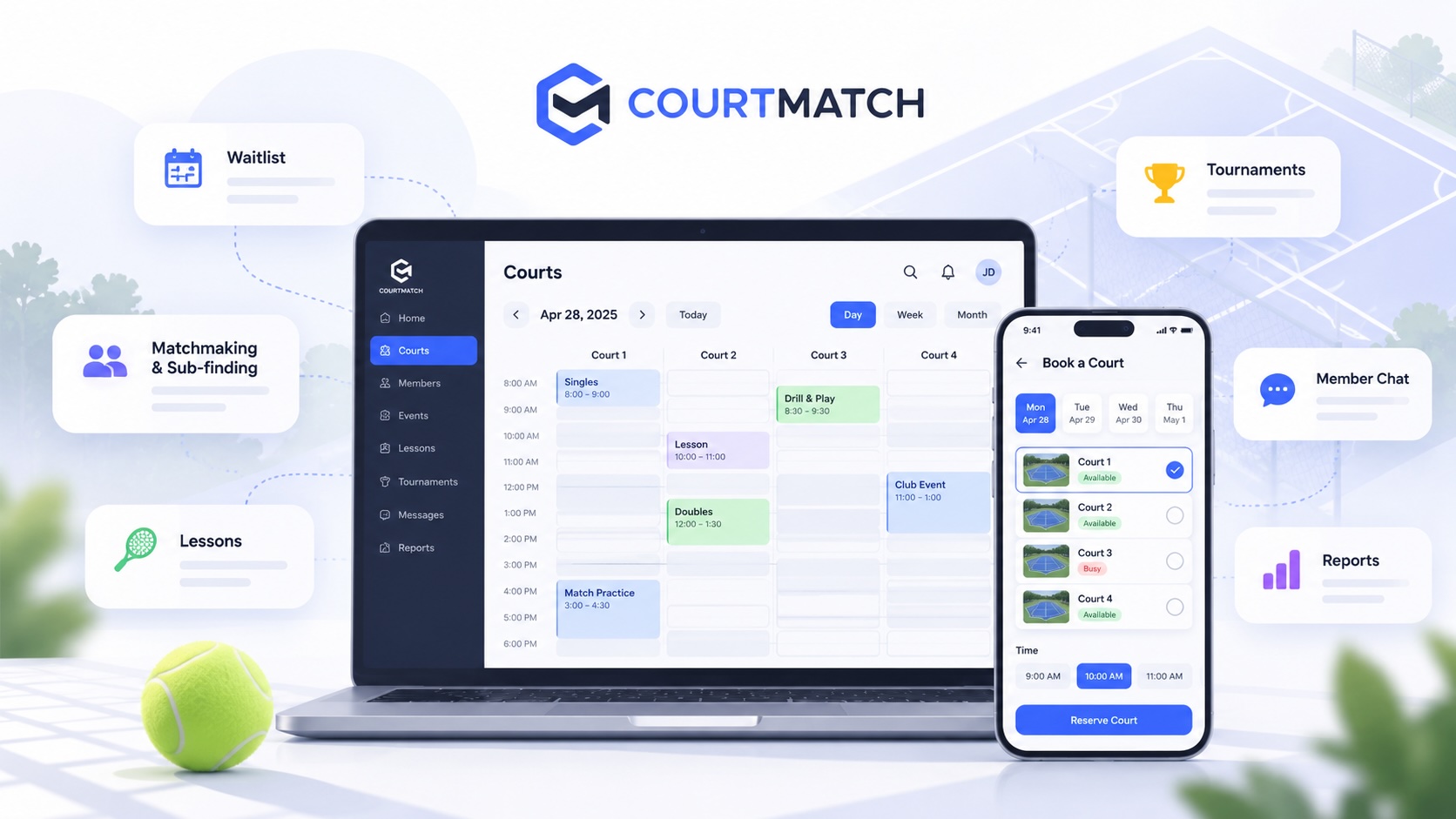
The best tennis court reservation software is becoming less about maintaining a calendar and more about managing the flow of activity around the club. Reservations connect to lessons, leagues, tournaments, waitlists, member communication, matchmaking, payments, reporting, and even the relationships members form with one another. That shift is happening at exactly the right time. The USTA reported a record 27.3 million U.S. tennis players in 2025, with 14.5 million playing at least 10 times during the year. Those players generated more than 616 million play occasions, up from 384 million in 2018. USTA
For club operators, that's a lot more than a participation statistic. It means more people competing for courts, more programming to coordinate, more opportunities to create organized play, and a much greater need to understand how facilities are actually being used.
The Front Desk No Longer Needs to Be the Reservation System
The first meaningful change court reservation software created was simple: members stopped needing staff to complete routine transactions.
That matters more than it sounds. Every phone call to check availability, cancel a court, move a reservation, or ask about tomorrow's schedule interrupts somebody at the club. Multiply that across hundreds or thousands of members and the administrative cost becomes substantial.
Now members expect to handle those tasks themselves, usually from a phone. That expectation isn't unique to tennis. Pew Research Center found that 91% of U.S. adults owned a smartphone in 2025, including 90% of adults ages 50 to 64 and 78% of those 65 and older. Pew Research Center
That makes the mobile experience an important part of evaluating tennis club software. Members should be able to see real-time availability, make a reservation, add players, cancel, join a waitlist, or find another opportunity to play without needing staff assistance.
The operational benefit is obvious. Staff spend less time acting as reservation agents and more time doing the things that actually require a person.
Clubs Can Finally See How Their Courts Are Really Being Used
Paper calendars and phone reservations could tell you whether a court was booked. They weren't particularly good at telling you what that meant.
Modern tennis court reservation software creates a much richer picture. Which courts are busiest? When does demand peak? Which times consistently go unused? How often are members canceling? Where do waitlists form? Which programs are consuming court inventory? Are certain membership groups having difficulty getting access?
That information changes the way a club can operate.
If Tuesday afternoons are consistently underutilized, perhaps that's an opportunity for a league, clinic, discounted lesson block, or social program. If Saturday morning courts have persistent waitlists, the club can look at reservation rules or how organized programming is allocated. If a particular clinic continually fills while another struggles, programming can be adjusted based on actual behavior rather than anecdotal feedback.
At CourtMatch, we've been expanding reporting and AI insights for exactly this reason. The goal isn't to give an administrator another dashboard to stare at. It is to make the data generated by everyday member activity useful enough to help make better decisions.
Reservations Have Started Connecting to Participation
This is where I think the biggest change is happening.
A reservation system traditionally answered one question: When is a court available?
But that's not always the question the member is trying to answer. Sometimes it's: Who can I play with?
A new member may see ten available courts and still not have a game. A doubles group may have a court reserved until one person cancels. Someone may be unexpectedly free at 4:00 but have no idea who else might want to hit.
This matters because tennis is not struggling to attract interest. According to the USTA, 4.9 million people played tennis for the first time in 2025, while the player retention rate reached a five-year high of 80.4%. USTA The opportunity for clubs is helping those people turn occasional participation into a regular habit.
That's why CourtMatch connects reservations with matchmaking and sub-finding. A member who wants to play should be able to find compatible players, while a group that loses somebody should have a way to find a replacement. The objective is not simply to manage court inventory. It is to turn more of that inventory into actual tennis.
Waitlists Have Become More Intelligent
A full court schedule sounds like a good problem to have until cancellations start creating holes.
Older systems often treated a waitlist as exactly what the name suggests: a list. Someone canceled, staff figured out who was next, contacted that person, waited for an answer, and then moved down the list if necessary.
Software can handle much of that work now.
Smart waitlists can alert eligible members when availability changes and help fill spaces that otherwise might go unused. That same idea applies beyond individual courts to clinics, programs, leagues, tournaments, and lessons.
This is a good example of automation that benefits everyone without feeling impersonal. The club protects utilization and revenue, staff avoid repetitive work, and the member gets an opportunity to play that they might otherwise have missed.
Court Scheduling Has Become Connected to the Rest of the Club
A tennis court doesn't exist in isolation. The same inventory may be used for individual reservations, private lessons, team practices, leagues, ladders, clinics, tournaments, camps, and social events.
When those activities live in separate systems, somebody has to keep them synchronized. Usually that somebody is a staff member.
Modern platforms can connect them.
An instructor's availability can be considered alongside court availability. A recurring lesson can automatically reserve the appropriate court. Tournament courts can be blocked directly as part of running the event. A program registration can affect capacity and waitlists without someone manually updating another calendar.
This is one reason we've built leagues, ladders, tournaments, lessons, programs, and reservations inside CourtMatch rather than treating reservations as the entire product. The more those functions understand one another, the fewer opportunities there are for double-bookings, workarounds, and spreadsheets.
The Technology Is Starting to Follow the Entire Member Experience
The next evolution of tennis court reservation software may have surprisingly little to do with reservations.
Consider what happens during a normal member's relationship with a club. They reserve courts, find players, take lessons, communicate with friends, enter tournaments, join leagues, get their racquet restrung, and try to improve their game.
Historically, club software handled only pieces of that experience. Everything else happened through outside apps, text messages, paper forms, spreadsheets, or conversations at the desk.
That boundary is disappearing.
CourtMatch's Racquet Services, for example, lets a club coordinate restringing with members while maintaining their service history and preferences and sending reminders and notifications. AI Coach lets instructors upload video of a member and receive detailed swing analysis they can use as an additional coaching tool. Tournament accomplishments can become part of a player's member profile. In-app chat and group messaging allow the community around the tennis to continue inside the club's technology.
None of those things are necessary to reserve Court 3 at 10:00 Saturday morning.
That's precisely what makes them interesting.
The Real Question Is No Longer "Can Members Book a Court?"
Almost every credible tennis reservation system can answer that question with yes.
The better questions are what happens next.
Can the platform help fill courts that might otherwise sit empty? Can it help a new member find people to play with? Can a doubles group recover from a cancellation? Can staff understand utilization without spending hours building spreadsheets? Can tournaments and leagues use the same member and court data? Can members communicate without immediately leaving for WhatsApp or GroupMe? Can instructors, lessons, and courts be coordinated together?
Those are operational questions, but they're also member-experience questions.
The USTA's latest participation data shows a sport with tremendous momentum. Tennis has added nearly 10 million U.S. players since 2019, and the number of annual play occasions has climbed by more than 60% since 2018. USTA
The challenge for clubs is no longer simply putting reservations online.
It is using technology to turn all that demand into more play, stronger relationships, better experiences, and a club that's easier to run.
That's how tennis court reservation software has really changed club operations, and I suspect we're still in the early stages of what it will become.