
Looking for a CourtReserve Alternative? What Clubs Should Consider Before Switching
Switching club software is one of those projects nobody volunteers for. Members have to learn something new, staff have to move data and rethink workflows, and there is always the fear that some process everyone takes for granted will suddenly become harder. So if a club is searching for a CourtReserve alternative, there should be a better reason than simply wanting newer software.
CourtReserve is a capable platform, and it has expanded significantly. Its current offering includes court reservations, lessons, programs, memberships, payments, public booking, waitlists, reporting, a player match-maker, flex leagues, stringing, integrations, and more. Its published pricing currently ranges from $199 per month for its Launch plan to $549 per month for Momentum before annual-billing discounts, with different capabilities included at each level. CourtReserve That means a useful comparison shouldn't start with "What does CourtReserve lack?" It should start with a different question: What kind of member experience are you trying to create, and how much of that experience do you want your club technology to own?
That distinction is becoming increasingly important. Tennis reached a record 27.3 million U.S. players in 2025, with 14.5 million playing at least 10 times during the year. USTA Pickleball reached 24.3 million U.S. participants, including 7.5 million core players who played at least eight times. Sports & Fitness Industry Association Clubs are not just managing more reservations. They are managing more relationships, more organized play, more communication, more competition, and a lot more opportunities to turn occasional players into highly engaged members.
Start With What Happens After the Reservation
Court reservations are important, but they are increasingly becoming the entry point to the member experience rather than the experience itself.
Let's say a member wants to play tomorrow at 5:00. Booking the court is the easy part. What if they don't have an opponent? What if their doubles partner cancels that afternoon? What if they're new to the club and don't know anyone at their level? What if they want to turn that casual match into a regular group?
CourtReserve does offer a Player Match-Maker, and its reservation settings can allow players already on a reservation to substitute other players. help.courtreserve.com If you're evaluating alternatives to CourtReserve, though, don't stop at whether both products can check a "matchmaking" box. Actually walk through the member's experience. How does someone announce that they need another player? How easy is it for compatible members to discover that opportunity? Can a club create a community where available players and available games naturally find each other?
This is one of the reasons we built both matchmaking and sub-finding into CourtMatch. The goal isn't simply to maintain a directory of people who might want to play. It is to remove the gap between "I'd like to play" and "I have a game."
Look Closely at What Still Requires Another Platform
Integrations can be incredibly useful. No software company should try to build every possible capability itself. But there is an important difference between integrating with specialized technology and requiring another platform to complete a core member experience.
Organized play is a good example. CourtReserve currently integrates with Swish for several league and event formats. According to CourtReserve's own documentation, players and event information are transferred into Swish, which then handles scheduling, score tracking, rotations, and live updates. The documentation also states that the integration currently does not support tournament formats. help.courtreserve.com CourtReserve also integrates with Pickleheads for pickleball leagues, although its documentation says tournaments are not currently supported through that integration either. help.courtreserve.com
There is nothing inherently wrong with that model. A club may prefer assembling specialized products and connecting them. But it creates a useful question when evaluating a CourtReserve alternative: Which experiences do we consider important enough that we want them built directly into our club platform?
At CourtMatch, tournaments, leagues, ladders, team formats, registration, scheduling, communication, results, and member accomplishments are designed as parts of the same system. When someone wins a tournament, that accomplishment doesn't have to disappear when the event ends. It can become part of their member profile and the history they're building inside the club. That is a subtle distinction on a software comparison sheet, but it feels very different to the player.
Ask Where Your Club's Community Lives
This is probably one of the most overlooked questions in club technology.
CourtReserve's published communication features include email marketing, SMS and push notifications, announcements, automated reminders, and alerts. CourtReserve Those are useful tools for communicating from the club to the member.
But a lot of what makes a racquet club feel like a community happens between members.
Players are creating doubles groups, asking who wants to hit tomorrow, looking for substitutes, discussing league matches, coordinating tournament partners, and making plans after play. If the club's technology doesn't give them a place to do that, those conversations naturally move into text messages, WhatsApp, GroupMe, Facebook groups, or wherever somebody decided to start a chat.
That means a club can have very sophisticated management software while much of its actual community lives somewhere else.
CourtMatch includes direct in-app chat and group messaging because we think communication is part of participation. A group created around a league can keep talking after the match. Players who meet through matchmaking can communicate without exchanging phone numbers first. The digital community becomes an extension of the physical community rather than a separate layer of technology members have to assemble themselves.
Consider Everything Members Do at the Club, Not Just What They Book
There is another limitation to evaluating software from a traditional feature checklist: the checklist tends to reflect what club software has historically done rather than what it could do.
Take racquet stringing. CourtReserve has recognized this need and now includes a stringing module on its Advance plan and above. CourtReserve That's a good example of club software expanding beyond bookings.
We've taken a similar idea further with CourtMatch Racquet Services. A player and club can coordinate racquet service, maintain the player's service history and equipment preferences, and use reminders and notifications to help manage future service. The value isn't really "having a stringing feature." It is that another part of the player's relationship with the club becomes connected to everything else the club knows about them.
Coaching presents an even bigger opportunity. Scheduling a lesson is useful, but scheduling doesn't make the lesson better. CourtMatch's AI Coach allows instructors to upload video of a member's swing and receive a detailed AI-generated analysis they can use as another coaching tool. It isn't there to replace the teaching professional. It gives the professional more information to work with and gives the member another way to understand their development.
This is the kind of question clubs should increasingly ask when comparing racquet club software: Does this technology only manage the activities we already offer, or can it help us make those activities better?
Don't Underestimate the Cost of Fragmentation
Subscription price is easy to compare. Fragmentation is harder.
If one system manages the club, another runs competitive events, another handles messaging, another provides video analysis, and staff still maintain spreadsheets for processes that don't fit anywhere else, each individual product may work perfectly well. The cost shows up in other places: additional subscriptions, more logins, more training, duplicated data, more integrations to maintain, and members who aren't always sure where they are supposed to go.
CourtReserve has leaned heavily into integrations and currently lists connections for areas including events, ratings, video recording, access control, food and beverage, retention marketing, and other systems. help.courtreserve.com For some organizations, that's exactly the right architecture. They may want a central management platform surrounded by best-of-breed tools.
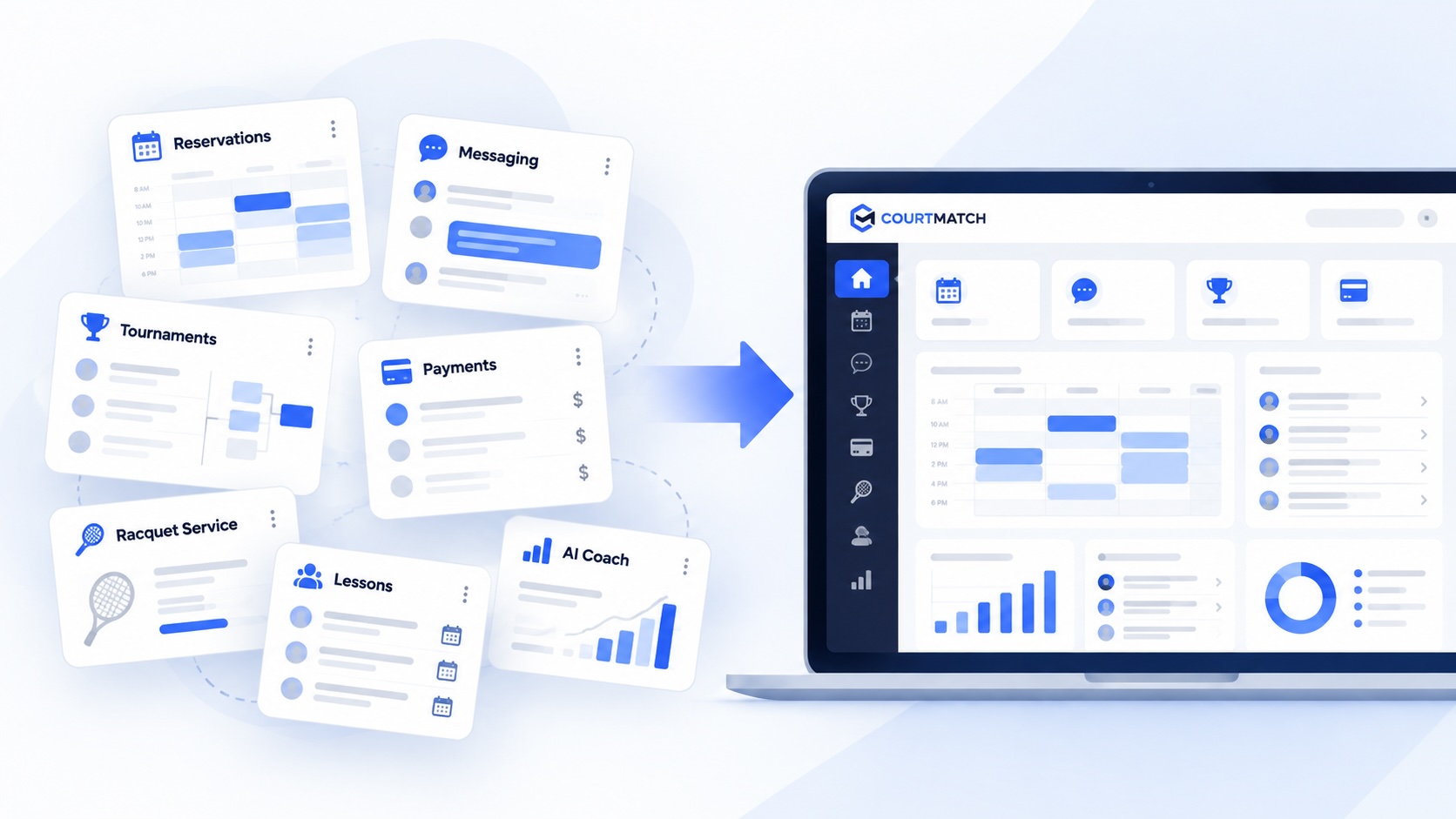
CourtMatch is making a different bet. We believe many of the experiences that drive participation and engagement are more valuable when they are native and interconnected. Reservations, matchmaking, sub-finding, messaging, tournaments, leagues, ladders, lessons, member achievements, racquet services, and coaching tools can reinforce one another because they share the same member experience.
Neither philosophy can be evaluated properly by simply counting features.
When Staying With CourtReserve May Make More Sense
A search for CourtReserve alternatives shouldn't automatically end with switching platforms. If your staff understands CourtReserve, members are happy with it, the integrations you use work well, and the platform supports the experience you're trying to deliver, migration may create more disruption than value.
That's especially true for a club using its software primarily for reservations, payments, lessons, memberships, and traditional program administration. CourtReserve has a substantial feature set in those areas, and switching simply because another product has a few different features may not justify the effort.
The equation changes when your club's strategy is centered on increasing participation, connecting members, consolidating more of the experience into one platform, or using technology to create entirely new member experiences. Then it becomes worth looking beyond whether the basics work.
How to Evaluate a CourtReserve Alternative
Don't run the demo from a feature checklist. Create a handful of real situations your members and staff encounter and ask each vendor to show you exactly what happens.
Have a new member who doesn't know anybody find a game. Have a doubles group lose its fourth player two hours before a reservation. Run a tournament from registration through the final result. Ask the winners what appears on their member profiles afterward. Have a player message a league group. Book an instructor and a court. Put somebody on a waitlist and then cancel another player's registration. Drop off a racquet for stringing. Have an instructor analyze a member's swing video.
Then watch how many times you leave the platform, create a workaround, open another app, or ask an administrator to intervene.
That exercise will tell you far more than a 100-row software comparison spreadsheet.
CourtReserve has become a broad racquet club management platform, and any fair evaluation should acknowledge that. The reason to consider a CourtReserve alternative isn't that CourtReserve can't manage a club. It clearly can.
The more interesting question is what you expect club management software to become.
If you believe its primary job is managing courts, memberships, payments, and programs, there are several mature platforms capable of doing that. If you believe the next generation of club technology should also help members find people, build relationships, communicate, compete, improve, participate more often, and carry their club identity with them digitally, the comparison starts to look very different.
That's the future we're building CourtMatch around.