
The Economics of a Court: Getting More Value From the Space You Already Have
A Court Is More Than a Line Item on a Site Plan
A court takes up a surprising amount of valuable real estate. It has to be built, resurfaced, lit, cleaned, insured, staffed around, and eventually renovated. In some communities, adding another one may cost hundreds of thousands of dollars before anyone ever hits a ball. Yet once courts are built, the conversation around them often becomes strangely simple: Are they booked or not? That leaves out the more useful question, which is whether the space is creating enough value for the people who paid for it. A court that hosts a packed junior clinic, a weekly league, a lesson, and an evening doubles match is doing something very different for a community than one that sits empty for much of the day and becomes impossible to reserve from 5:00 to 8:00. Understanding court economics starts with recognizing that utilization is not just a scheduling issue. It is a way to understand whether one of the organization's most expensive recreational assets is actually serving the community well.
Full Courts Can Still Hide a Capacity Problem
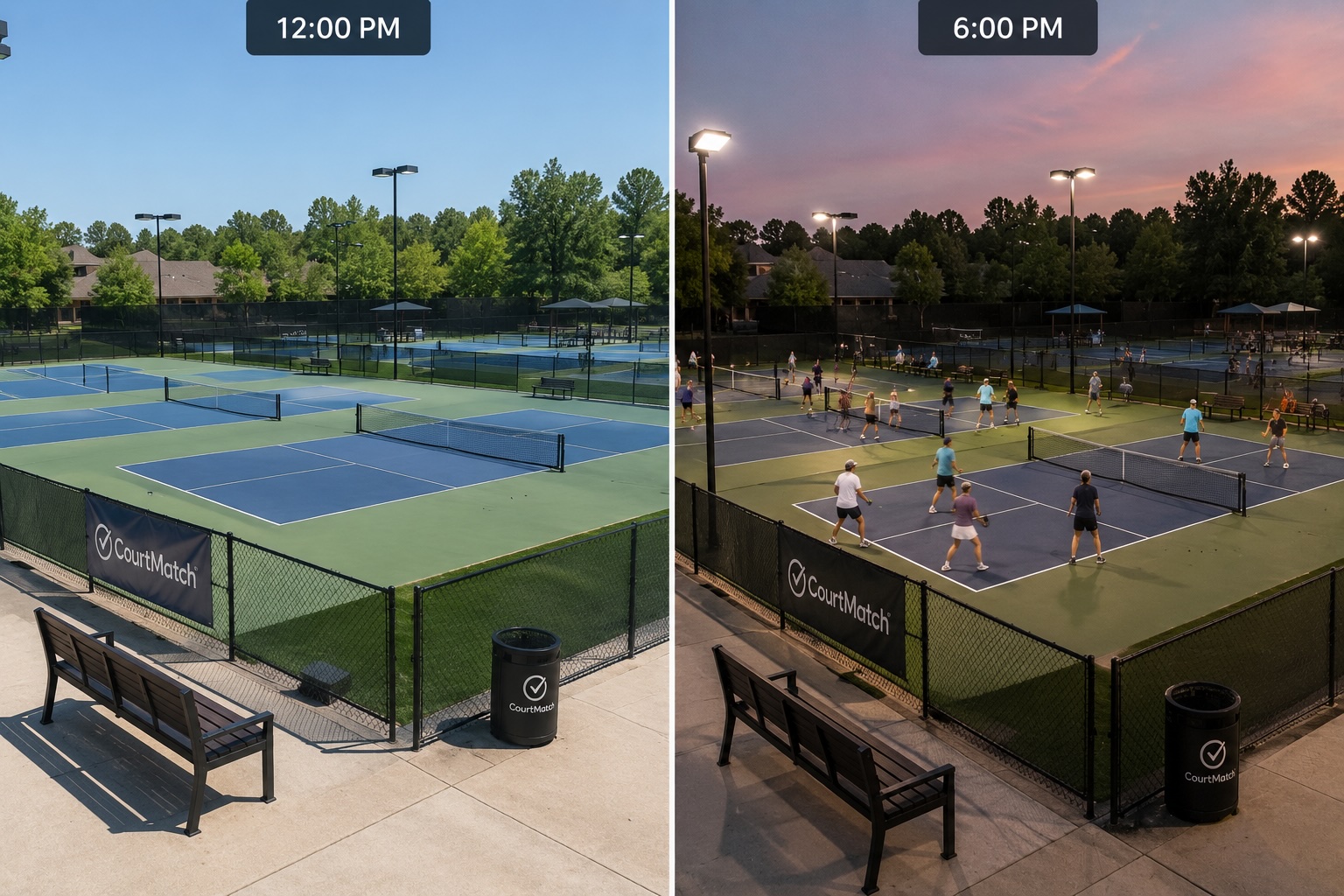
Seeing every court occupied at 6:30 on a Tuesday evening can make a facility look enormously successful. It can also hide the fact that those same courts were nearly empty for most of the afternoon. This is where raw utilization numbers become misleading. If a facility is 55 percent utilized overall but effectively 100 percent full during the few hours when members actually want to play, the experience may feel overcrowded even though a significant amount of capacity is going unused. That matters because the obvious solution, building more courts, may not be the best one. Adjusting programming times, shifting lessons into quieter periods, creating incentives for off-peak play, improving waitlists, or changing reservation rules can sometimes relieve pressure without pouring another slab of concrete. Before an HOA board, municipality, or club spends heavily on expansion, it should know whether it has a true capacity shortage or simply a demand distribution problem.
Not Every Hour Creates the Same Value
There is another layer that is easy to miss: occupancy and value are not always the same thing. A casual reservation absolutely has value because providing access is one of the main reasons courts exist. But the same court can also support a beginner clinic that brings new people into the sport, a league that keeps dozens of players engaged for months, or a junior program that connects an entire family to the community. In a private club, some of those activities may also generate direct revenue. In an HOA or municipal setting, the return may show up differently through resident satisfaction, participation, stronger programming, or better use of an amenity residents are already funding. The point is not to commercialize every available hour. That would quickly destroy the experience. The point is to think deliberately about the mix. Open court access, lessons, leagues, social play, events, juniors, and other programs all compete for finite space, and the best schedule is the one that creates the greatest overall value without making members feel that every court has been programmed away.
The Cost of an Empty Court Is Easy to Ignore
Empty capacity rarely creates the same urgency as overcrowding because nobody complains about a court that isn't being used. Financially and operationally, however, repeated periods of low utilization should get attention. The organization is still maintaining the surface, paying for lighting and surrounding infrastructure, and allocating land to an amenity that may not be delivering what it could. Sometimes the answer is simple. Perhaps nobody wants to play outdoors at 2:00 PM in August, and no amount of clever scheduling is going to change that. In other cases, low use may point to something fixable. Members might not know about available programming. Beginners may have no easy way to find partners. A clinic may be scheduled at the wrong time. Players may assume courts are unavailable because the reservation experience is cumbersome. Understanding why space goes unused is much more valuable than simply observing that it does.
Expansion Should Be the Last Question, Not the First
When demand grows, conversations about new courts tend to become emotional quickly. Tennis players want tennis courts. Pickleball players want pickleball courts. Padel advocates see an opportunity to bring something new to the community. Leadership is left trying to decide how much space to dedicate to each group, often using a combination of complaints, anecdotes, and educated guesses. That is an expensive way to make a facilities decision. Before changing or expanding the footprint, organizations should understand reservation demand, waitlists, program participation, peak-hour congestion, cancellations, sport-by-sport usage, and how those patterns are changing over time. A court that looks underused today may serve a rapidly growing program. Another that appears constantly busy may be dominated by a relatively small group of frequent players. When these decisions are backed by real participation data, discussions become less about which group argues most effectively and more about what the community actually needs.
Better Economics Should Produce a Better Member Experience
The phrase "court economics" can sound like the goal is squeezing more money out of every square foot. It shouldn't be. The real objective is making better decisions about a scarce and expensive resource so that more people can enjoy it. Sometimes that will increase revenue. Sometimes it will mean moving a program, changing a reservation policy, improving communication, or resisting the urge to build another court that isn't actually necessary. The important part is having enough visibility to understand what is happening rather than relying on instinct alone.
A well-run facility should be able to answer relatively simple questions about its courts: when they are busiest, when they are underused, what activities create the strongest participation, where demand is being turned away, and how those patterns are changing. Once that information is connected with programs, lessons, leagues, events, and membership activity, the economics become much easier to understand. The smartest investment is not always another court. Sometimes it is getting more value, more participation, and a better experience from the courts you already have.