
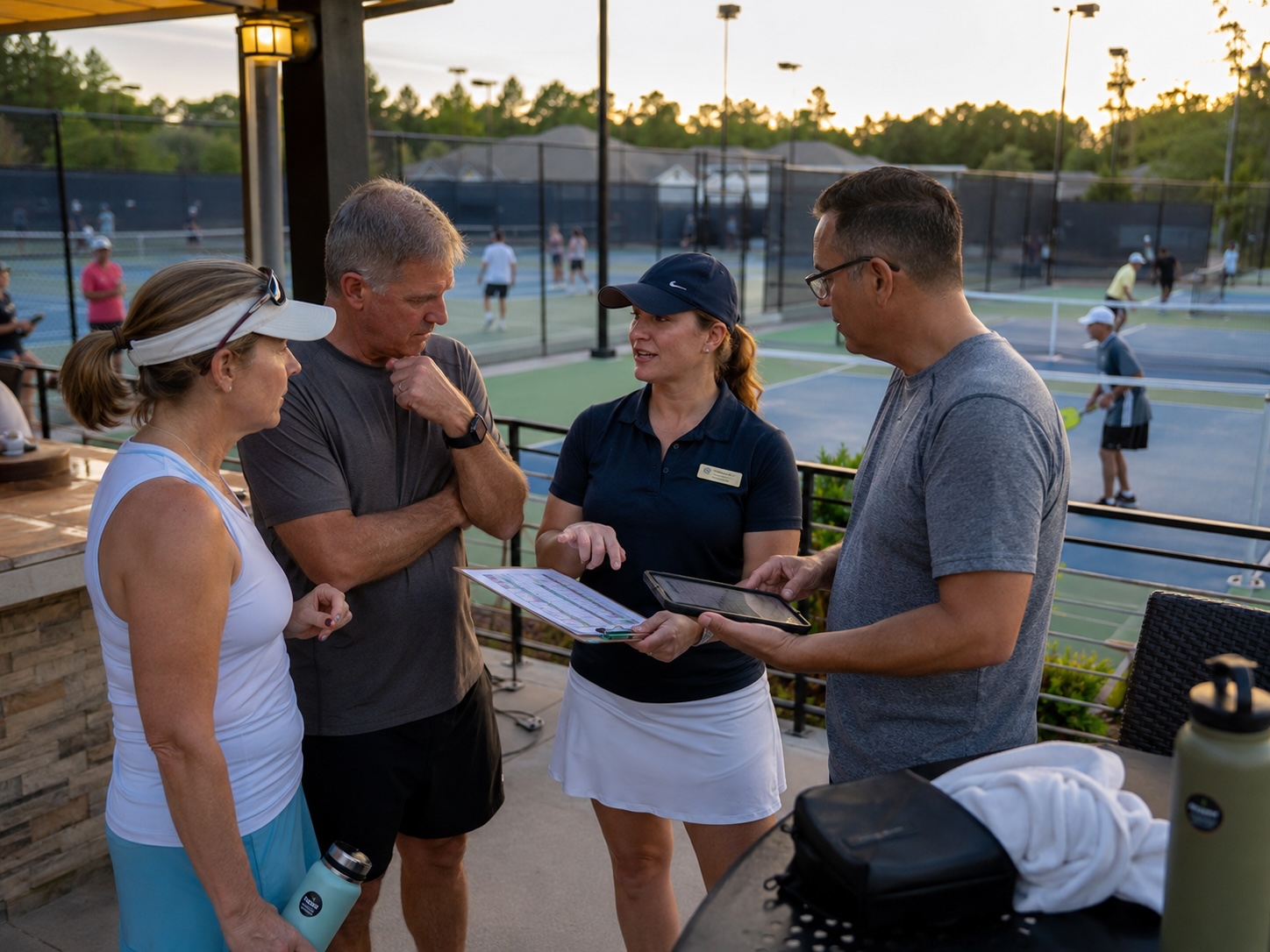
The Hidden Cost of Court Conflicts and How Communities Can Prevent Them
Court Conflicts Are Rarely About Courts
Few issues create more frustration in a club or community than court conflicts.
On the surface, these disputes appear to be about scheduling, access, or facility usage. One group believes they're not getting enough court time. Another feels their preferred playing hours are being reduced. Residents complain about noise. Members question reservation policies. Tennis players and pickleball players debate how available court space should be allocated.
The discussions often focus on courts, but the underlying issue is usually something much bigger.
Court conflicts are fundamentally about fairness.
People want to know that they have a reasonable opportunity to participate in the activities they enjoy. When they believe access is unfair, frustration grows quickly. If that frustration isn't addressed, it can damage member satisfaction, create divisions within the community, and place significant strain on staff, volunteers, HOA boards, and club leadership.
As participation continues to grow across tennis, pickleball, and padel, managing these expectations is becoming one of the most important challenges facing modern racquet sports communities.
Growth Has Created New Pressures
A decade ago, many facilities were focused on increasing court utilization. Today, many are trying to manage the opposite problem.
Pickleball participation has exploded. Tennis participation continues to grow. Padel is expanding rapidly in many markets. As more players enter the ecosystem, demand for courts naturally increases.
This growth is positive, but it creates operational challenges that many communities were never designed to handle.
Prime-time court availability becomes scarce. Popular programs fill immediately. Open play sessions become crowded. Members begin competing for limited resources, particularly during evenings and weekends when demand is highest.
The challenge becomes even more complicated when multiple sports share the same facility. Every decision regarding court allocation affects someone. Adding pickleball courts may create opportunities for one group while reducing availability for another. Expanding programming may increase participation overall while limiting open court access.
These aren't simply scheduling decisions. They're community decisions.
The Cost of Conflict Is Higher Than Most Communities Realize
When court conflicts arise, organizations often focus on the immediate issue. A complaint needs to be addressed. A reservation policy needs to be adjusted. A scheduling dispute needs to be resolved.
What is often overlooked is the broader impact these conflicts have on the community.
Every disagreement consumes time and attention from staff, board members, volunteers, and club leadership. Instead of focusing on improving the member experience, people spend their energy managing disputes.
Conflicts also have a tendency to become emotional. Members rarely view court allocation through the lens of utilization reports or operational efficiency. They view it through personal experience. If they feel they're losing access to something they value, the conversation can quickly become charged.
Over time, repeated conflicts can erode trust. Members begin questioning decisions. Groups become protective of "their" court time. Conversations shift from collaboration to competition.
This is why the most successful communities don't simply react to court conflicts. They actively work to prevent them.
Transparency Solves More Problems Than Policies
Many organizations respond to court conflicts by creating more rules.
Sometimes that's necessary, but rules alone rarely solve the underlying problem.
People are often willing to accept outcomes they don't love if they understand how those outcomes were determined. What creates frustration is uncertainty. When members don't understand why decisions are being made, assumptions quickly fill the gap.
Transparency helps address this challenge.
Communities that openly communicate court allocation strategies, reservation policies, utilization trends, and long-term planning decisions tend to experience fewer conflicts than those that make decisions behind closed doors.
Members may still disagree with certain decisions, but they're far more likely to trust a process they can understand.
This is especially important when introducing changes. Whether a facility is converting courts, adding programming, adjusting reservation policies, or expanding access for new player groups, communication should begin long before the change occurs.
People support what they understand.
Data Should Inform Decisions
One of the biggest mistakes communities make is relying on the loudest voices instead of the best information.
Every club has passionate members. Every HOA has residents with strong opinions. Every municipality receives feedback from users who care deeply about their preferred activity.
Listening is important, but leadership also requires objectivity.
Utilization data often tells a very different story than member perception. A group may feel they're being underserved when actual usage patterns suggest otherwise. Another group may appear highly active while large portions of their allocated court time sit unused.
The goal isn't to let data make decisions. The goal is to use data to make better decisions.
Understanding peak demand, court occupancy rates, reservation trends, program participation, and usage patterns allows communities to allocate resources more effectively while reducing the likelihood of conflict.
The most successful organizations combine member feedback with objective data rather than relying exclusively on either one.
The Best Communities Focus on Shared Success
Court conflicts become most difficult when participation is viewed as a zero-sum game.
If one group wins, another group loses.
If one sport grows, another sport suffers.
If one program receives more court time, another receives less.
While these situations occasionally occur, the healthiest communities work hard to avoid this mindset. Instead of asking which group deserves more, they focus on how the facility can create more value for everyone.
That may involve expanding programming, improving scheduling efficiency, increasing utilization during off-peak hours, or creating new opportunities for participation. It may also involve helping different groups understand that they share the same objective: a thriving, active community.
The strongest clubs and communities recognize that court space is a limited resource, but community engagement is not. When participation grows, relationships strengthen, and members feel valued, everyone benefits.
Final Thoughts
Court conflicts are becoming more common as participation in racquet sports continues to grow. While these disputes often appear to be about scheduling, reservations, or court allocation, they're usually rooted in deeper questions about fairness, transparency, and access.
The organizations that navigate these challenges most successfully aren't necessarily the ones with the most courts. They're the ones with the clearest communication, the best visibility into facility usage, and the strongest commitment to creating fair opportunities for participation.
Because in the end, the goal isn't simply to manage courts.
It's to build communities where people feel they have a place to play, compete, connect, and belong.