
What to Look for in Pickleball Court Reservation Software
A full pickleball court can be a sign that everything is going right and a warning that things are about to get complicated.
As participation grows, the easy part is getting people interested in playing. The harder part is deciding who gets the courts at 6:00, managing open play without frustrating members, filling the spot when someone cancels, organizing leagues and tournaments, helping new players find games, and keeping staff from becoming the human connection between a reservation calendar, a spreadsheet, a group text, and three other apps.
That is why choosing pickleball court reservation software should involve much more than comparing calendars.
The Sports & Fitness Industry Association reported that 24.3 million Americans played pickleball in 2025, up from 4.2 million in 2020. Even more important for facilities, the number of core players who participated at least eight times per year grew from 1.4 million to 7.5 million during that period.
Those aren't just impressive growth numbers. They represent millions of people looking for places, times, and other people to play with. For clubs, the challenge is increasingly about managing participation rather than simply taking reservations.
Start With the Reservation Rules, Not the Calendar
Almost every credible platform can show a member an available court and let them book it. The differences become obvious when you start adding the rules that exist in a real facility.
Can you establish different booking windows for different membership types? Can you limit how many prime-time reservations someone can hold? Can singles, doubles, lessons, open play, leagues, and tournaments have different rules? Can courts be blocked for maintenance or recurring programs without somebody rebuilding the schedule every week? Can guest policies and fees be applied automatically?
Pickleball can make these questions particularly important because court demand is often concentrated into specific periods and different forms of play compete for the same inventory. A facility may have private reservations, drop-in play, instructional programs, leagues, round robins, tournaments, and social events all trying to use the same courts.
USA Pickleball's latest growth report lists 82,613 known courts across 18,258 U.S. locations, with more than 2,300 new locations added during 2025 alone. Even with that facility growth, managing existing capacity efficiently remains incredibly important.
So during a software demo, don't just ask someone to book Court 4 at 10:00. Give them your actual rules and ask them to recreate them. The software should conform to the way your facility operates instead of forcing your facility to conform to the software.
An Available Court Doesn't Mean You Have a Game
One of the biggest limitations of traditional pickleball reservation software is that it solves the court problem without necessarily solving the player problem.
Imagine a member unexpectedly gets Wednesday afternoon free. There are three available courts, but everyone they normally play with is working. The reservation calendar has done its job perfectly and the member still isn't playing pickleball.
Or four players have a court booked for tonight and one cancels at 3:00. Three people now start texting friends, posting in a group chat, or deciding whether to cancel altogether.
Those are exactly the kinds of problems technology should be able to solve.
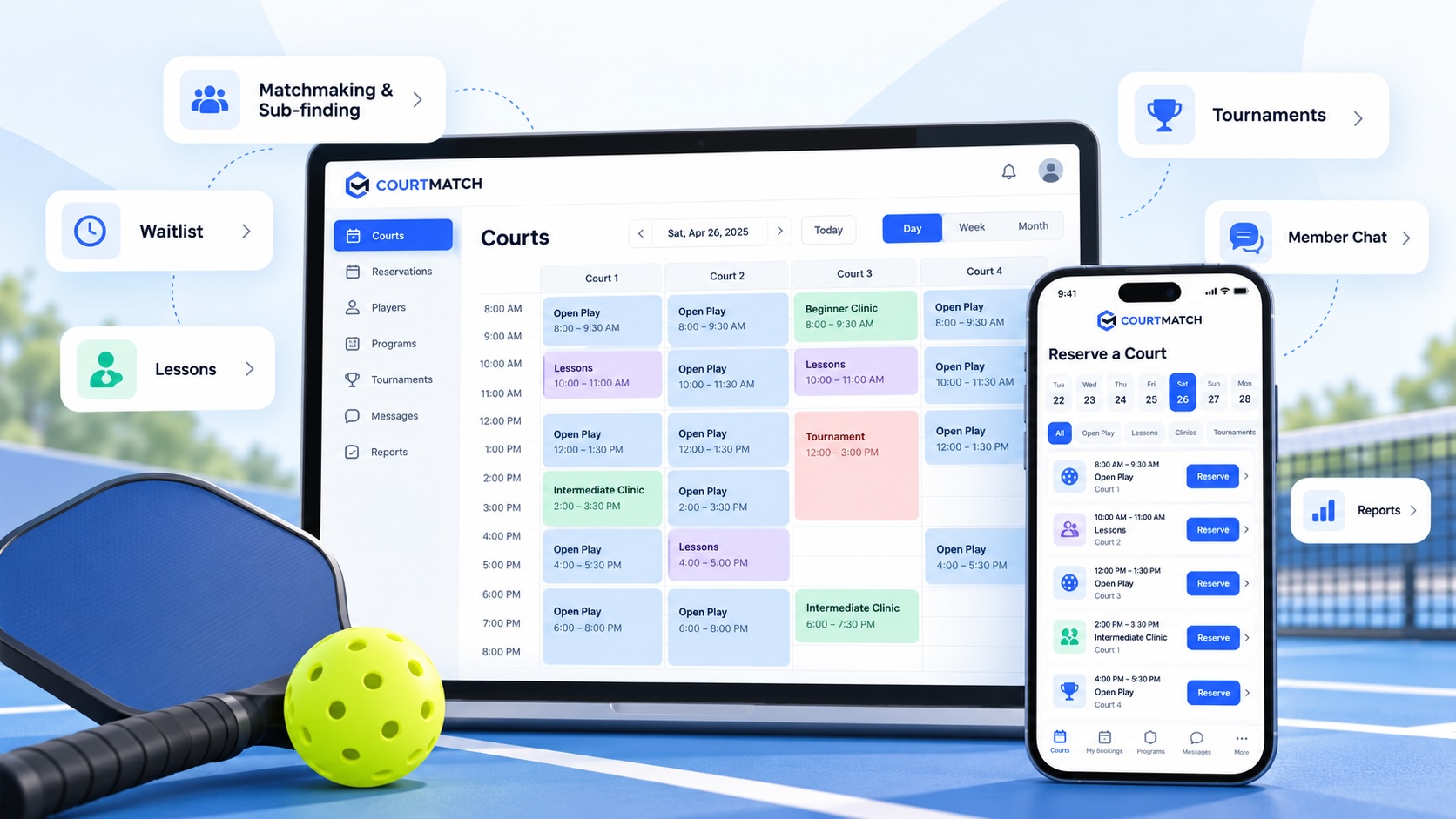
At CourtMatch, we connect court reservations with both matchmaking and sub-finding. Someone looking to play can find compatible players, and a group missing a player can look for someone appropriate to fill the game. That relationship between people and courts matters because a club's objective shouldn't simply be maximizing reservations. It should be maximizing meaningful participation.
This is particularly important for new members. Giving somebody access to a reservation system does not make them part of the club. Helping them find people they enjoy playing with might.
Open Play Needs More Than an Event on the Calendar
Pickleball has a culture that is different from traditional private court booking. Open play, drop-in sessions, rotations, skill-based groups, round robins, and other communal formats are a big part of the sport.
That means software needs to understand the difference between reserving a court and managing a playing opportunity.
If 32 people want to attend an open-play session with capacity for 24, what happens? Can the system maintain a waitlist and automatically help fill openings? Can skill or membership restrictions be applied? Can staff communicate changes with the people who are actually registered? Can the facility see whether certain sessions consistently fill while others struggle?
This is where smart waitlists become particularly useful. A cancellation should not immediately turn into an empty spot and another task for the front desk. The platform should be capable of helping the next eligible player take that opening.
The result is better utilization without forcing staff to constantly monitor the schedule.
Pickleball Is Social, So the Software Should Be Too
There is another reason player connectivity deserves more attention in pickleball software.
A 2025 national study of 825 U.S. adults over age 50 found that current pickleball participation was associated with lower perceived loneliness, while people who had played reported more social connections and social engagement. The researchers appropriately caution that the study demonstrates an association rather than proving that pickleball directly causes those outcomes, but the findings reinforce something players already understand intuitively: the social experience is a meaningful part of the sport.
That makes it strange that the digital experience at many facilities still ends with the reservation.
Members leave the club app and move into SMS, WhatsApp, GroupMe, Facebook, or some other communication channel to coordinate the actual activity surrounding the reservation. Eventually the club's physical community has a digital counterpart that exists almost entirely outside the club.
CourtMatch includes direct member chat and group messaging because we think the community should extend into the technology. Players can coordinate games, groups can communicate, and relationships created through matchmaking, leagues, or tournaments can continue inside the same environment.
That does more than eliminate another app. It helps the club remain part of the experience between visits.
Leagues and Tournaments Should Connect to the Courts
Organized competition is another area where clubs can end up with unnecessary technology fragmentation.
A league may be managed in one platform while the courts live in another. Tournament registration happens somewhere else. Results need to be transferred back. Players communicate in a group chat. Somebody on staff keeps a spreadsheet around because one of those systems doesn't quite do what the club needs.
It works, but every handoff introduces another opportunity for confusion.
The better model is for organized play to understand the facility where it is happening. A tournament should know which courts it is using. A league schedule should connect with availability. Players should be able to register, communicate, compete, report results, and see their history without bouncing between unrelated products.
CourtMatch includes leagues, ladders, and tournaments directly within the platform for this reason. Tournament victories and other accomplishments can also become part of a player's profile, so the competition contributes to their identity and history within the club rather than disappearing after the final game.
USA Pickleball sanctioned 144 tournaments in 2025, while its National Championships brought together more than 2,500 competitors from 47 states and 20 countries. Competitive and organized play is clearly an important part of where the sport is headed.
Look for Data That Helps You Change What Happens Next
Reservation data should do more than tell you how many courts were booked last month.
A facility should be able to understand which times consistently reach capacity, which courts are underused, where waitlists form, which programs produce the strongest participation, how often cancellations occur, and whether different groups of members are actually engaging with the facility.
The interesting question isn't just, "What was our court utilization last month?"
It's, "What should we do because of what we learned?"
Maybe a lightly used Tuesday afternoon should become organized open play. Maybe persistent Thursday evening demand means a reservation rule needs to change. Maybe a clinic should expand. Maybe a league format should be added for a group of players participating regularly but not entering existing programs.
CourtMatch's reporting and AI insights are being built around that idea. Data becomes much more valuable when it helps operators identify opportunities instead of simply documenting history.
Test the Mobile Experience Like an Actual Player
This sounds obvious, but it's easy to forget when buying club software.
The administrator making the decision may spend hours evaluating reporting, settings, and backend configuration. Members will spend most of their time on a phone.
So use it.
Find a court. Reserve it. Add another player. Find somebody to play with. Look for a substitute. Join open play. Get on a waitlist. Register for a league. Send another player a message. Cancel a reservation.
Then give the app to someone who hasn't participated in the software evaluation and ask them to do the same things without instructions.
If normal pickleball activities require training, the problem probably isn't the member.
The Best Pickleball Court Reservation Software Should Reduce Friction Between Wanting to Play and Actually Playing
The explosion in pickleball participation means facilities have a remarkable opportunity. SFIA's research shows participation grew almost 480% between 2020 and 2025, while the core player population increased by more than five times.
Those players don't need software because they love reservation calendars.
They need a court. They need other players. They need a fourth when someone cancels. They want open play, leagues, tournaments, lessons, competition, communication, and community.
That is why the most important question when choosing pickleball court reservation software isn't simply whether people can reserve courts.
Ask whether the platform makes the entire path to participation easier.
Can members find people? Can groups find substitutes? Can waitlists save openings? Can organized play happen without another system? Can players communicate? Can staff understand demand and make smarter programming decisions? Can the platform make all of that easier without increasing the administrative burden?
A good reservation system manages courts.
The better opportunity is technology that helps keep those courts filled with people who want to play.